The Head Start
Generative AI reached 62% of American adults in three and a half years. The internet needed eight. The climb rate is about the same. What differs is where each one started, and who's paying for it.
I asked Claude for a graph this week. I’d been assuming that AI is being taken up faster than the internet was, and I wanted to see it drawn. The assumption held. What I didn’t expect was the shape of the win, which says more about what happens next than the headline does.
The American curve
The cleanest data is American. Alexander Bick, Adam Blandin and David Deming have run a nationally representative survey of generative AI use every quarter since August 2024, and they line it up against the PC and the internet by counting years from each technology’s first mass-market product: the IBM PC in 1981, the opening of the internet to commercial traffic in 1995, ChatGPT in November 2022.
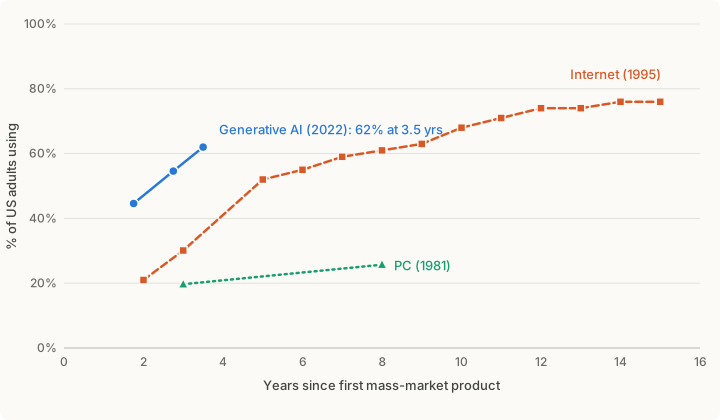
In August 2024, not quite two years in, 44.6% of Americans aged 18 to 64 were using generative AI. A year later it was 54.6%. By May 2026 it was 62%. Three years after its own launch the internet stood at 30.1%, and the PC at 19.7%. The internet didn’t reach 61% until 2003, its eighth year. AI got there in three and a half.
Same climb, different start
Look at the slopes, though, and they’re not very different. Generative AI has been adding about ten points a year. The internet added 8.6 points between 1997 and 1998 and then roughly eleven a year up to 2000. The blue line isn’t steeper than the orange one. It starts higher. AI was past 40% before anybody had a survey in the field, and it’s been climbing at an internet-like pace ever since.
So the lead was won in the first eighteen months, and the reason isn’t mysterious. To get on the internet in 1996 you needed a computer, a modem, a phone line you were willing to tie up and an ISP account. To get on ChatGPT in 2022 you needed a browser tab. The internet had to build its own infrastructure before anybody could adopt it. AI inherited the internet’s.
The world
The global picture is rougher, because nobody surveys the planet every quarter. The best available series is Microsoft’s AI Economy Institute, which models the share of people aged 15 to 64 using a generative AI product from its own telemetry. For the internet there’s the ITU.
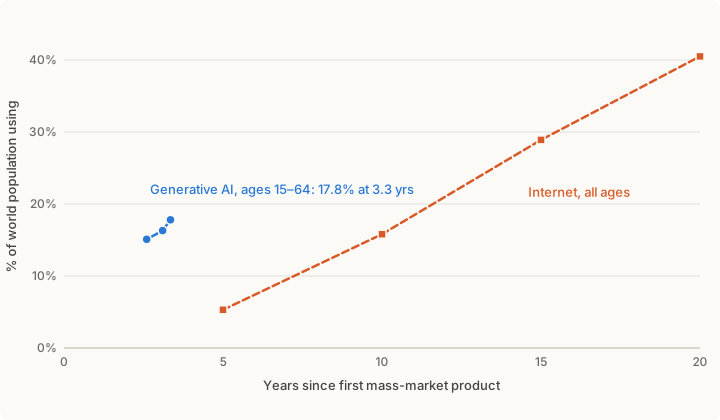
Microsoft has 15.1% of the world’s working-age population using AI in the first half of 2025, 16.3% in the second half and 17.8% in the first quarter of 2026. The internet was at 5.3% of world population in 2000 and 15.8% in 2005, so it needed ten or eleven years to reach what AI reached in a bit over three. And again the climb is ordinary: AI added 1.2 points between the two halves of 2025, then a quicker 1.5 in the first quarter of 2026; the internet ran at about two points a year through 2005 and nearer four by the late 2010s.
There’s one thing in the global chart that has no precedent in the internet’s own history. AI can’t spread to anybody who isn’t online, and the ITU puts 2.2 billion people there, with 74% of the world connected in 2025. The internet’s ceiling was the species. AI’s ceiling is the internet. Microsoft’s own figures show the gap widening, too: 27.5% in the Global North against 15.4% in the South, a gap that went from 10.6 points to 12.1 between one report and the next. For what it’s worth, Ireland is fourth in the world at 48.4%, behind the UAE, Singapore and Norway.
The money
Adoption is one curve. Revenue is another, and the internet’s history says the two can part company.
The internet’s first native business model was advertising, and the IAB has the receipts. US online ad revenue was $267 million in 1996, $907 million in 1997, $1.9 billion in 1998, $4.6 billion in 1999 and $8.1 billion in 2000. Then it fell, to $7.1 billion in 2001 and $6.0 billion in 2002, a drop of about a quarter from the peak, and it didn’t pass its 2000 level again until 2004. Over those same two years the share of American adults online went from 52% to 59%. People kept arriving while the money left.
AI’s revenue curve makes the internet’s look sedate. Anthropic’s annualised run rate was about $1 billion in December 2024 and $9 billion at the end of 2025. Bloomberg reported it past $65 billion at the end of July 2026, with preliminary second-quarter revenue above $11.5 billion against $787 million a year earlier, and positive adjusted operating income for the quarter. OpenAI’s run rate was reported above $40 billion in August. Run rates aren’t booked revenue, and the two companies may not count the same way, but there’s no reading of those numbers in which the internet of 1999 is in the same race. The whole US online ad market took five years to reach $8 billion.
The difference is who’s paying. The internet couldn’t get its users to pay, so it sold their attention. AI is mostly selling work. Anthropic’s revenue is reported to be around four-fifths enterprise and API. ChatGPT has something like a billion users, of whom by one count about one in twenty subscribes, and OpenAI began putting ads in front of the rest on 9 February 2026, opening a self-serve ad manager to all US advertisers on 5 May. So the attention model has arrived here too, but second, and as the smaller line. The survey data agrees about where the value is turning up: the share of employed Americans who’d used generative AI for work in the past week went from 28.2% in the third quarter of 2024 to 39.2% in the second quarter of 2026, and the share of all work hours it assisted from 4.1% to 6.3%.
What I got wrong in May, and what still stands
In $965 Billion and a Date I put Anthropic’s new valuation against its last published revenue of around $14 billion and got a multiple near 69. Against $65 billion it’s under 15. I said the round didn’t buy an exemption from arithmetic, and it didn’t; the arithmetic moved instead, faster than I thought it could. That needs saying plainly.
What hasn’t moved is the other side of the ledger. Amazon, Microsoft, Alphabet and Meta are on course to spend roughly $725 billion on capital expenditure this year by the Financial Times’ tally, up from about $410 billion in 2025, and guidance went up again at second-quarter earnings. The two biggest labs together are running at a little over $100 billion a year. That’s a far better ratio than the one I quoted in May, and it’s still about seven to one, on hardware that depreciates on a calendar of its own.
The internet’s lesson isn’t that the revenue was fake. It’s that adoption and revenue are separate curves, and the second one can fall by a quarter while the first keeps climbing. Anybody reading 62% and rising as a reason the money can’t stumble is reading the wrong chart.
A note on the numbers
The US series aren’t perfectly matched. The AI survey asks about any use and covers ages 18 to 64; Pew covers all adults; the 1997 ITU figure is access. The August 2024 AI figure was first published as 39.4% and revised to 44.6% after the authors tested their question ordering, so older write-ups quote the lower number. The internet wasn’t at zero in 1995, which is why neither curve is drawn from the origin.
The global series are further apart. Microsoft’s figure is modelled from its own product telemetry and covers ages 15 to 64; the ITU’s covers everybody. Microsoft also puts the United States at 31.3% in early 2026, about half what the St. Louis Fed survey finds for nearly the same population two months later. One measures modelled active use and the other asks people whether they’ve used it. I’d treat the global 17.8% as a floor.
The company revenue figures are press reports of investor documents, not audited accounts.
Todd McCaffrey is a New York Times bestselling author, researcher and solo developer, with an MSc in Cyberpsychology from ATU Letterkenny. The charts and research for this piece were produced with Claude, which is made by Anthropic, one of the companies discussed.
Further Reading
- The Rapid Adoption of Generative AI — Bick, Blandin & Deming, Federal Reserve Bank of St. Louis
- The State of Generative AI Adoption in 2025 — St. Louis Fed, On the Economy
- What Work Does Generative AI Do? — St. Louis Fed, On the Economy
- Internet, Broadband Fact Sheet — Pew Research Center
- The state of global AI diffusion in 2026 — Microsoft On the Issues
- Global AI Adoption in 2025: A Widening Digital Divide — Microsoft AI Economy Institute
- Statistics: Individuals using the Internet — ITU
- IAB Internet Advertising Revenue Report, 2004 full year — IAB / PricewaterhouseCoopers
- Anthropic's annualized revenue surges to $65B — TechCrunch
- Anthropic's revenue run rate reportedly surpasses $65 billion pre-IPO — Axios